

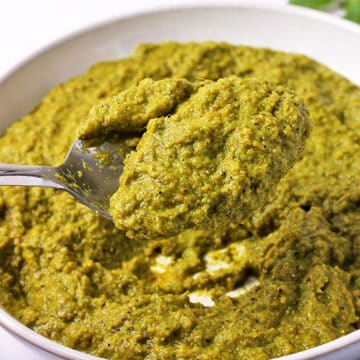
This vegan Thai green curry paste is made from scratch with fresh herbs, toasted spices, and zero oil. And because it’s homemade, you get all the fresh flavor with full control of the ingredients, flavor, and spiciness.

If you love Thai green curry but hate guessing what’s actually in store-bought pastes or finding an affordable whole food version, this recipe is for you.
Just like my Thai vegan red curry paste or nut-free massaman curry paste, this recipe makes a big batch that’s freezer-friendly for quick curry dinners or dressing up leftover veggies.
🔎A Quick Look At This Recipe
- Prep time: 25 minutes
- Cook time: 5 minutes
- Total time: 30 minutes
- Yield: about 1 cup (enough for 3–4 curries)
- Flavor: Fresh, citrusy, herb-forward, and spicy as you like it.
- Texture: Smooth and spoonable, and oil-free clean.
- Diet: Vegan, oil-free, whole-food focused.
- Method: Toast and grind whole spices, then blend all the ingredients.
SUMMARIZE AND SAVE THIS CONTENT ON:
Table of Contents
Why Homemade Curry Paste Beats Store-Bought
- No more searching ingredient labels – you have full control to make a vegan curry paste at the ‘just right’ heat level for you.
- No added oil, preservatives, or fillers.
- Brighter color and fresher flavor.
- It tastes fresher, looks brighter, and works harder than anything from a jar.
Ingredients & Substitutions

- Whole spices. I toasted coriander and cumin seeds and ground them because they are more aromatic and flavorful. You can also substitute with ground spices. And, if you’re short on time, just grind the whole spices.
- Green chilies. I used two types of chilies – Thai green chilies and jalapenos. You can mix and match other chilies depending on your preferred spice level. If you want a milder curry paste, even a green bell pepper and one jalapeno can be used.
- Lemongrass. Peel away tough outer layers and dice finely for a smooth blend. Lemongrass paste is the best substitute.
- Shallots. Mild and slightly sweet (red onion works if needed).
- Miso paste. Savory umami without fish sauce. If you need a gluten-free curry paste, be sure to check the labels on your miso paste. Soy-free miso paste is also available.
- Cilantro and basil. Use both leaves and stems for maximum flavor. If you can get Thai basil, it’s the best option, but if not, use standard Italian basil.
Please see the recipe card at the bottom of this post for the complete list of ingredients, measurements, and instructions.
How Spicy is Green Curry Paste? (And How to Control the Heat)
Green curry paste is known for its spicy heat. When you make it yourself, you’re in charge.
Here’s how to adjust it easily:
- Start with fewer chilies. Use 2 green chilies and 1 seeded jalapeño, then taste after blending.
- Remove seeds and white pith. Cut the chilies in half and use a small spoon or paring knife to reduce heat without sacrificing flavor. The white part is the hot part, which is why removing it helps with heat control.
- Choose chilies carefully. Many packaged chilies have a heat level on the package, but fair warning, individuals vary. I’ve ended up with a super-hot jalapeno in a bunch.
- Adjust after blending. You can always add more chili - removing heat is much harder.
Want to save this recipe? 🥣
Recipe Instructions

Step 1: Toast the coriander and cumin seeds in a hot skillet. Stir constantly for about 30 seconds. Transfer the toasted seeds to a spice grinder and grind them into a fine powder.

Add all the ingredients to a small-capacity blender and blend until smooth, scraping down the sides and under the blade as needed. (more equipment information below)
Denise's Pro Tips
- Dice the lemongrass very finely for the smoothest paste.
- Grind the whole spices before adding the other ingredients. If you forget, the curry paste will still taste delicious – it just won’t be as smooth.
Equipment Tips
- I used a NutriBullet 600 to grind the spices and make the curry paste. If you only have a large blender or food processor, all is not lost. It just requires a little more diligence in scraping the sides and underneath the blade.
- If you’re using a small spice grinder to make the paste, batch blend by adding a few ingredients at a time.
- Curry paste is traditionally made using a pestle and mortar. I’ve tried it, but it takes time and muscle. If you use this method, start with finely chopped ingredients, and pound the whole spices first.
How to Use Green Curry Paste

Use 1–4 tablespoons per curry, depending on how bold you want the flavor.
This curry paste is delicious in Thai vegetable and tofu curry, mango coconut curry, in soups, or as a noodle sauce with peanut butter, sweetener, and a little rice vinegar.
Frequently Asked Questions
For the freshest flavor, refrigerate for 1 -4 weeks in an airtight container. Freeze for up to 6 months, in individual portions or in ice cube tray slots.
Traditionally, no. Many versions contain shrimp paste or fish sauce. This homemade version is fully vegan.
Start with 1 tablespoon and increase up to 4 tablespoons for a full curry recipe (4-6 servings. The amount depends on taste and the spiciness of the curry paste.
Traditionally, no. Many versions contain shrimp paste or fish sauce. This homemade version is fully vegan.
Thai green curry paste is bright and citrusy from lime and lemongrass, deeply aromatic from cilantro and basil, and gently warming from toasted spices, and spicy with fresh green chilies.
Hungry for more? Subscribe to my newsletter and follow me on Facebook, Pinterest, and Instagram for all the newest recipes!
👩🏻🍳 Recipe
Thai Green Curry Paste Recipe (Vegan & Oil-free)
Rate this Recipe:
Ingredients
- 1 tablespoon coriander seeds - 2 teaspoons ground
- 2 teaspoons cumin seeds - 1 teaspoon ground
- 2 stalks lemongrass - chopped (see note 1)
- 1 medium lime - zest and juice
- 2 tablespoons ginger - grated (see note 2)
- 5 cloves garlic - minced (about 1 tablespoon)
- 2-4 medium Thai green chilies - clean out the seeds and whit pith (see note 3)
- 1-2 medium jalapenos - clean out the seeds and white pith (see note 3)
- ½ cup shallots - roughly chopped (substitute with red onion)
- ¾ teaspoon ground white pepper
- 1 teaspoon ground turmeric
- 1 teaspoon miso paste
- ½ cup cilantro - leaves and stems
- 10 medium basil leaves - Thai or more common Italian
Instructions
- Heat a small skillet or cast-iron pan over medium heat. Add the coriander and cumin seeds. Stir constantly for 30 seconds to toast the seeds. Immediately remove them from the heat.
- Add the whole spices to a spice grinder or small-capacity food processor like a NurtiBullet. Grind into a fine powder.
- If you have a larger spice grinder or small food processor, add the rest of the ingredients and blend until smooth. If not, transfer the ground spices to a food processor, and add the remaining ingredients before blending.
- Scrape the sides and bottom of the blend to ensure a smooth blend. Add a little more lime juice if the paste is dry or too chunky after blending.
- Makes about 1 cup (enough for 3-4 curries).
Notes
- To prep the lemongrass, cut off the bottom and top, then peel away the tough outer layer. Either pound the stalk with a wooden mallet or use a rolling pin to mash the stalk a bit so it’s easier to cut. I recommend dicing lemongrass before blending to ensure the smoothest curry paste.
- Grate or mince the ginger so you have an idea of how much to use. There’s no need to peel it, although you can use a spoon or paring knife to scrape away thicker skin if desired.
- I used a combination of Thai green chilies and a jalapeno. If you are unsure of the heat level, I recommend starting with 2 green chilies plus 1 jalapeno, then testing after you blend the curry paste.
- To store: refrigerate green curry paste for 1-2 weeks or freeze it in small portions or ice cube tray slots for up to 6 months.
- Use 1-4 tablespoons of curry paste per curry as desired.
Nutrition
Nutritional information is an estimation only.



Leave a Reply